Friday, 27 January 2017

Commemorative Event in Bradford, Yorkshire, UK, Wednesday, 8th March 2017, 7.15 p.m.

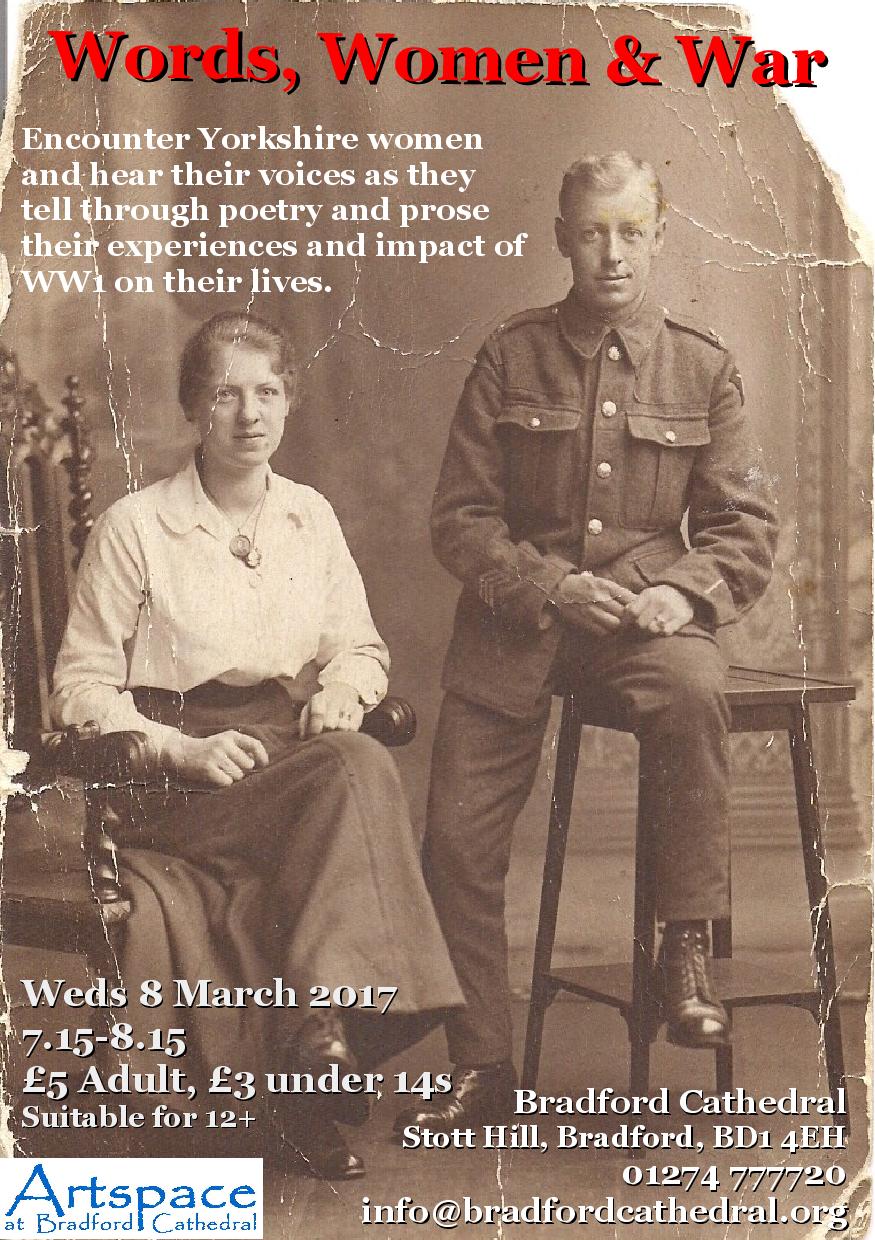
Some time ago, writer Irene Lofthouse contacted me via the weblog, regarding female poets and writers from Yorkshire.

I am delighted to announce that Irene has been back in touch with to tell me that she is holding a one-woman event commemorating the First World War.   Entitled “Words, Women &  War”, this is about Yorkshire women in poetry and prose and will be held on Wednesday, 8th March 2017 from 7.15 pm. – 8.15 pm at Bradford Cathedral.

Bradford Cathedral, Stott Hill, Bradford, Yorkshire, BD 1 4EH

Tickets from £5.  For further information, please see the attached flyer.

Thursday, 5 January 2017

A New Year Message from Down Under

I had a delightful New Year’s greeting from a lady called Maxine Amos who hails from Australia.  Maxine had looked at the Inspirational Women weblog and she got in touch with me via e-mail.
“We are a small Family History Association in Townsville, North Queensland, Australia, and I am the editor of our magazine which is published 3 times a year, approx 350 A5 copies. Copies are also sent to the State and National archives and to other Family History Associations around Australia and overseas.”
To find out more about the Association please see their website http://www.fhanq.org/
Being in touch with people all over the world who are interested in the history of the First World War is one of the most rewarding aspects of my commemorative exhibition project.  Thank you Maxine and Happy New Year to you and all members of your Association.  
 

Saturday, 31 December 2016

Lise Rischard - a housewife from Luxembourg - British Secret Agent in WW1

Among the inspirational women of the First World War on my list is Lise Rischard, an 'ordinary' housewife from Luxembourg.   Officially neutral in WW1, the people of Luxembourg had suffered greatly during the wars that ravaged Europe in the previous years.   Lise's son by her first marriage - Marcel Pelletier - was a member of the French Olympic Team sent to the Olympic Games held in Stockholm in 1912.

During a visit to her son, who was in the French Army and in Paris before being sent to the Front, Lise was recruited to help the Allied cause.  Her story is amazing as she travelled from her home in Luxembourg in the area held by the Germans via Switzerland to Paris, which remained a free city during WW1, and then set up a network to provide vital information to the British.

I mention Lise in "No Woman's Land" but you can find out the whole amazing story in the book 'The Secrets of Rue St. Roch' by Janet Morgan (London: Allen Lane, 2004).

Friday, 23 December 2016

Talk and exhibition: Volunteers and Voters: World War 1 and its Legacy - Wednesday, 18th January 2017 6 - 7 p.m.

World War 1 enabled a number of Worcestershire women to develop their skills and spheres of influence through voluntary work and prepared them to use their newly acquired vote in 1918. 

This talk and exhibition, by University of Worcester Lecturer Professor Maggie Andrews, to be held at The Hive in Worcester on Wednesday, 18th January 2017, explores the legacy of The First World War for women such as 

Lady Isabelle Margesson, 
Mrs Hooper, 
Mary Pakington and 
Mrs Rusher 

who became Justices of the Peace, ran women’s organisations, wrote plays or campaigned for improvements in maternal and child welfare in the inter-war years.

These events are free of charge but booking is recommended.
Light refreshments are provided at the start of the event.
Wednesday, 18th January, 2017 from 6 – 7 p.m.

Book via
http://www.thehiveworcester.org/events.html

The Hive
Sawmill Walk
The Butts
Worcester
WR1 3PD

Marie Baudet (1864 – 1917) – French artist, writer, feminist and nurse

My very grateful thanks to Phil Dawes whose tireless research in response to my cry for help has produced much of the following information about Marie.

Marie was born Marie Ludivine Antoinette Dupuit in 1864 in Tagnon, Ardennes, France, which is about 28 kilometers from Rheims.  Her brother was Léon Dupuit and her great-nephew, Pierre Boucher – Léon’s grandson - was a Mayor of Tagnon.

In 1889, Marie married Victor Baudet, an accountant.

Marie became a nurse and worked in the French Hospital for Fishermen (Société Hôpitaux Français d’Islande) in Iceland that was set up in 1903 and in operation until 1912.   Marie was an ardent feminist and apart from French she also spoke Breton, Icelandic, Danish and English.  Some of Marie’s paintings were exhibited at the Salon d’Automne in Paris in 1907 and in 1913.   She also wrote a book about the beggars and tramps she loved to sketch. 

Marie undertook a pilgrimage to the Holy Land and travelled to Jerusalem.  She was instrumental in obtaining a sacred relic - a piece of the cross upon which Jesus was crucified - for keeping in the church in Tagnon.   Marie also organised a roadside ‘Calvary’ for her home town. These Calvaries are a traditional, commemorative religious area outside many towns and villages in France.  The Calvary on the outskirts of Tagnon was a large replica cross and was officially unveiled on 1st June 1914 when a special ceremony was held to dedicate the cross.  Hundreds of people attended the ceremony, with special trains bringing people from Rheims for the occasion. Marie painted the murals of the grotto at the base of the cross.

During the First World War, Marie worked at the hospital set up in October 1914 in the Palais de Compiègne to treat victims of the outbreak of Typhoid Fever. 

Marie may have been based at the St. Paul Hospital in Rheims.  She was killed during a bombing raid in the Place de la République in Rheims while helping wounded soldiers into an ambulance on 6th April 1917.

The Salon de Paris was an art exhibition started in 1903 by Matisse and other artists to counterbalance the rather conservative Salon de Paris which was founded in 1667 and organised by the Académie des Beaux-Arts in Paris.
 
Photo:  French nurses descending from a horse-drawn ambulance in 1914.

Sources:  Bénézit 1976, I, p. 515. Dictionnaire des peintres, sculpteurs, dessinateurs et graveurs.

Thursday, 15 December 2016

Henni Lehmann (1862 – 1937) – German artist, writer and social reformer.

With thanks to Debbie Cameron for finding this German artist.

"Fine art, in the strictest sense, is the first creative power in the world; it separates light and darkness, separates water and land; it creates animals and plants, the image of man, and the true artist Knows to breathe the breath of his soul into all, that it may live." (Henni Lehmann, 1914)

Henriette Straßmann was born on 10th October 1862 in Berlin. Her father, Wolfgang Straßmann (1821 - 1885), was a German physician, liberal politician and social reformer who was a Chairman of Berlin City Council.

In 1888 Henni married Karl Lehmann, a German legal scientist (1858 – 1918).  After their marriage they converted to Protestantism. The couple went to live in Rostock.

They had two children - Eva Fiesel (née Lehmann) (1891 - 1937) and Karl Leo Heinrich Lehmann, who became an archaeologist (1894 - 1960). From 1907 onwards, the family spent their holidays on the Island of Hiddensee. In 1909, Henni was one of the founding members of the Co-operative Shipping Company on the Island.  She was also very involved in the creation of better living conditions on the island.  In 1913 she gave the islanders a loan to build a house for the doctor and in 1914 she was one of the founders and first directors of Nature and Cultural Heritage of Federal Hiddensee.

Until the family moved to Göttingen in 1911, Henni Lehmann was chairman of Rostock Women's Association.   She campaigned for women to be allowed to have the same education as men and to be able to attend the most prestigious schools and universities.

During the First World War, Henni was director of the Göttingen Department of The National Women's Service (NFD) inside the Patriotic War Forum.

After her husband's death in 1918, Henni moved to Weimar.   During the Weimar Republic she joined the Socialist Democratic Party and became committed to helping the workers in their struggles.   Henni wrote socially motivated novels and gave lectures.  She was also a poet.

In 1919, Henni founded the artists group known as the Hiddensoer Künstlerinnenbund and also acquired a venue for holding exhibitions - the Kunstscheune, later called the Blaue Scheune - in Vitte.

From 1919 the Hiddensoer Artists met regularly in the Lehmann holiday home in Vitte.   Other members of the Group included Clara Arnheim , Elisabeth Büchsel and Käthe Loewenthal.

Diagnosed with Cancer, in order to spare her family – one of her children had died and the other had gone to live in America - Henni committed suicide on 18th February 1937.  Sources:  Debbie Cameron’s Facebook Page https://www.facebook.com/groups/1468972083412699/ and https://de.wikipedia.org/wiki/Henni_Lehmann

Wednesday, 14 December 2016

Book Review: “Menus, Munitions & Keeping the Peace The Home Front Diaries of Gabrielle West, 1914 - 1917”

Gabrielle West was born in 1883 and lived to celebrate her 100th birthday.  Her diaries were written as letters to her younger brother Michael, who worked for the Education Service in India and joined the 49th Bengal Regiment in 1918.   

 
Gabrielle’s diary begins in June 1914 and gives us a valuable insight into life in Britain just prior to the conflict.  Gabrielle worked in a variety of kitchens in convalescent hospitals and munitions factories and her diaries include details of how to feed a large number of people in wartime, which I found particularly interesting.

 
The munitions factories were targets of Zeppelin raids and Gabrielle describes some that she witnessed in great detail.    She also explains the layout of the factories and what each department produced, taking us on virtual tours – all illustrated with diagrams and drawings - which I found fascinating.

 
There was a brief period when Gabrielle was out of work. Her efforts to find paid employment are described in detail up to the moment when she and her friend responded to an advertisement in the women’s magazine “Home Chat” for women to join the newly formed Women’s Police Service to work at munitions factories. On 4th December 1916 Gabrielle became a woman police officer.   The Government's main concerns were the moral behaviour of the women workers who were doing dangerous work and being paid more than they had dreamed possible.  In the early days of their formation, women police did not have powers to make any arrests, in spite of some very hair-raising moments involving large numbers of women workers.   There is a wonderful photograph on page 127 showing Gabrielle and her fellow women police officers in their uniform, complete with tin helmets.

In 1917 the air-raids became more frequent, as did the problems with the workers in the factories, so Gabrielle and her colleagues had their work cut out to ‘keep the peace’.   The diaries end in May 1918 with a description of an explosion in the munitions factory in which Gabrielle was working at the time.  

Gabrielle’s Great Niece has added an Afterword that tells us that Gabrielle ran a successful tea room for a time after the war and though, like so many women of that generation, she never married, she had a full and happy life.   Also in the book you will find photographs of Gabrielle and her co-workers and background stories of Gabrielle’s family. 

 
I thoroughly enjoyed this book and would recommend it very highly – it is a very important contribution to the history of the First World War.  

“Menus, Munitions & Keeping the Peace The Home Front Diaries of Gabrielle West, 1914 - 1917” Edited by Avalon Weston and published by Pen & Sword, Barnsley, Yorkshire, 2016.