Saturday, 30 December 2017

The loss of HMS "Osmanieh" - 31st December 1917

Remembering the following nurses who died when the British Naval Auxiliary Fleet ship HMS “Osmanieh” was sunk by a mine from German submarine UC 34 off the coast of Egypt on 31st December 1917.   The Steam Ship “Osmanieh” was built by Swan Hunter & Wigham Richardson in Newcastle and launched in 1906.  She was requisitioned by the British Navy during WW1 and was en route from service in Gallipoli carrying troops and medical personnel to Alexandria when she was mined.   The Captain of the ship, 167 troops and 8 nurses lost their lives when the ship sank.
They are buried in ALEXANDRIA (HADRA) WAR MEMORIAL CEMETERY, Egypt

The nurses were:

Nursing Sister CATHERINE BALL of the Voluntary Aid Detachment. Drowned off Alexandria on 31st December 1917. Age 28. Daughter of John King Ball and Catherine Ball, of 25, Trent Bridge Footway, Nottingham. Grave Reference: B. 45.

Nursing Sister WINIFRED MAUD BROWN of the Voluntary Aid Detachment. Drowned in loss of H.M.S. "Osmanieh" off Alexandria, 31st December 1917. Age 30. Daughter of Arthur Brown, M.Inst. C.E., and Caroline Brown, of "Glenthorne," 3, Lucknow Avenue, Nottingham. Grave  

Nurse GERTRUDE BYTHEWAY. Voluntary Aid Detachment. Drowned in loss of H.M.S. "Osmanieh" off Alexandria, 31st December 1917. Age 37. Daughter of George and Lottie Bytheway, of Walsall, Staffs. Grave Reference: B. 42.

Nurse UNA MARGUERITE DUNCANSON of the Voluntary Aid Detachment. 31st December 1917. Age 25. Daughter of Mrs. H. F. Duncanson, of Pumps Court, Tovil, Maidstone. Grave Reference: B. 41.

Probationer Nurse (Special), NELLIE HAWLEY, 83/11/1057 of The Queen Alexandra's Imperial Military Nursing Service, attached to H.M.S. "Osmanieh" . Drowned in loss of H.M.S. "Osmanieh" off Alexandria, 31 December 1917. Age 29. Daughter of Alfred Arthur and Stella Hawley, of 29, Kingshall Rd., Beckenham, Kent. Grave Reference: B. 46. Nellie’s name is also on the War Memorial in the Grounds of Holy Trinity Church Beckenham, Kent, UK. Her name also appeared on the memorial at Malvern House School, Lewisham Park, which was destroyed in an air raid during the Second World War.

Nurse LILIAN MIDWOOD of the Voluntary Aid Detachment. Drowned in loss of H.M.S. "Osmanieh" off Alexandria, 31 December 1917. Age 32. Daughter of Mrs. E. G. Midwood, of London. Grave Reference: B. 43.

Staff Nurse M D. ROBERTS R/853. Queen Alexandra's Imperial Military Nursing Service, attd. H.M.S. "Osmanieh". Drowned in loss of H.M.S. "Osmanieh" (mine explosion) off Alexandria, 31 December 1917. Grave Reference: B. 44.

Nurse HERMIONE ANGELA ROGERS of the Voluntary Aid Detachment. Drowned, 31st December 1917. Age 22. Daughter of Francis Edward Newman Rogers and Louisa Annie Rogers, of Rainscombe, Marlborough, Wilts. Grave Reference: B. 39.

I wonder if anyone visits those graves?


Sunday, 24 December 2017

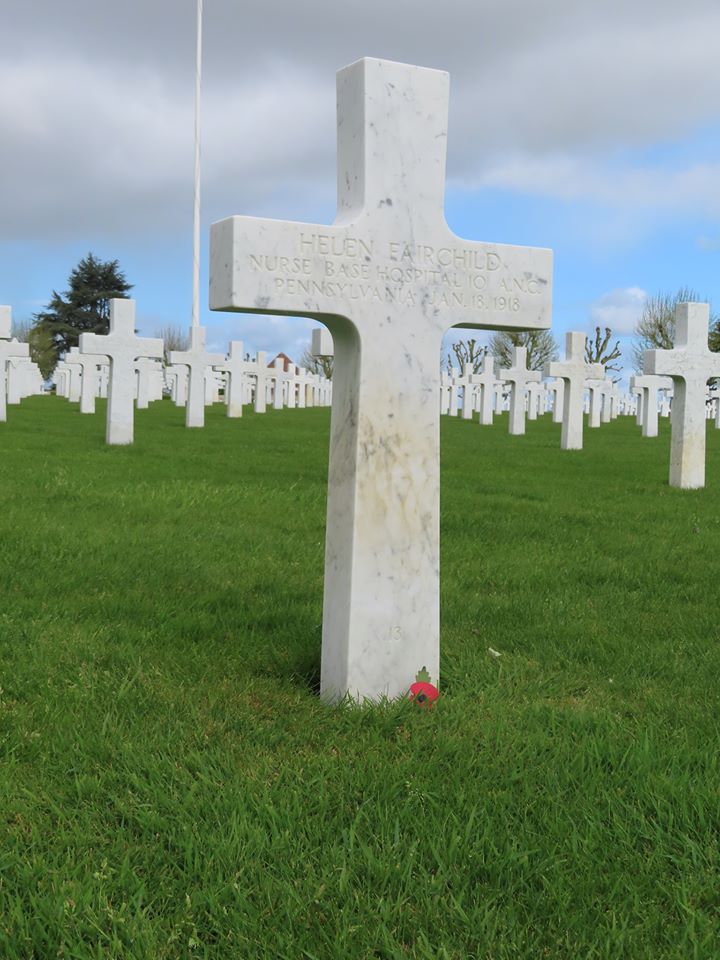
A Christmas 1917 message from American Nurse Helen Fairchild

American WW1 nurse Helen Fairchild was from Pennsylvania.  She died on 18th January 1918 while serving in France  with the American Nurse Corps.  Helen Fairchild is buried in the Somme American Cemetery.   This link is to her last letter home at Christmas 1917:

http://roadstothegreatwar-ww1.blogspot.co.uk/2013/12/a-christmas-letter-from-nurse-helen.html


Tom Isitt  @masaccio60 via Twitter added this:

Her niece self-published an interesting book about Helen’s war experiences. 


Grave of Helen Fairchild in The Somme American Cemetery, Bony, France, with a remembrance poppy kindly left by Andrew Mackay. 


Friday, 15 December 2017

BOOK REVIEW: “Tracing your Great War Ancestors: The Egypt and Palestine Campaigns – A Guide for family historians” by Stuart Hadaway, Pen & Sword Family History, Barnsley, Yorkshire, 2017.

Just prior to the onset of the First World War, the British Navy changed from using coal to using diesel oil, which meant it was vital to keep the oil wells and the Suez Canal in Allied hands.   The Egypt and Palestine Campaigns were therefore extremely important yet they are often forgotten in favour of the Western Front.   This book, which is illustrated throughout with superb photos, explains the background to the Campaigns – the signing of a secret treaty between the Ottoman Empire and Germany in August 1914 - and goes on to give detailed descriptions of the fighting in Egypt and Palestine and also explains how to go about searching for your family members who served in the armed forces during the conflict.  

Here you will find descriptions of the difference in the challenges and needs of the men fighting in a hot climate to the requirements of the Western Front, along with fascinating anecdotes such as the use of camels, elephants and mules.   As the granddaughter of a Gunner who served in Palestine during WW1, I was particularly interested in the detailed description of the different types of gun used by the Royal Horse Artillery, Royal Field Artillery and Royal Garrison Artillery and the logistical problems involved in getting the guns, ammunition and men to the right place at the right time.

I also read with interest about the health issues of the Campaigns and the setting up of the different medical facilities – Field Ambulances, Casualty Clearing Stations, Base Hospitals and so on – again all very different to those encountered on the Western Front.

I found the following particularly helpful - he map at the beginning of the book, the detailed instructions on tracing your WW1 ancestors, a chapter on Prisoners of War, the time-line of the Campaigns from 1st August 1914 up to July 1919, an extensive further reading list.
Do you know what ‘cacelots’ are?  I didn’t either but you can find out on page 86.

Stuart Hadaway has produced a very valuable and extremely readable book and I cannot recommend it highly enough - even if you do not have ancestors who served in that theatre of the war.

“Tracing your Great War Ancestors:  The Egypt and Palestine Campaigns – A Guide for family historians” by Stuart Hadaway, published by Pen & Sword Family History, Barnsley, Yorkshire, 2017 and costs £14.99.  For further information, please see the Pen & Sword website: https://www.pen-and-sword.co.uk/
 

Friday, 1 December 2017

Book Review: "The Lengthening War: The Great War Diary of Mabel Goode"

“The Lengthening War: The Great War Diary of Mabel Goode” is an extremely important social history record of the way of life of middle class people in Britain that disappeared completely after the First World War.   Edited by her great-nephew Michael Goode, and with a Foreword by Sir Chris Clark - Regius Professor of History at Cambridge University - Mabel’s diary takes us through the early days of the war and tell us how people at home saw the conflict develop and the effect it had on their lives.   Michael explains that Mabel’s perception of the war comes mainly from what she read in the newspapers – the quote from Lord Northcliffe about news at the start of Chapter two is particularly telling.  

 In the first seven chapters, Michael Goode explains the background to Mabel’s diary and her perception of the war and gives us photographs and biographical details about the three Goodes - Mabel and her two brothers, Henry, who became a doctor, and Stuart, who joined the British Army.  As teenagers, they spent some time living and studying in Germany.

Also included are copies of WW1 posters and postcards, as well as family photographs which serve to illustrate the text of Mabel’s diary.   There is also an index, a bibliography and explanatory notes on the text.

I was disappointed to find the final entry in Mabel’s diary was on 10th December 1916 as I would have loved to have read more of her writing.  Why did Mabel not continue writing her diary?  Was she too busy – we know that she studied art and after the war earned her living through painting.  During the war she knitted socks for the soldiers and bought jute to make sandbags to send to the troops at the front.   Mabel also helped out with hay-making and made cakes and so on to send to her brothers who were serving abroad.   There is however an Epilogue which explains what happened to Mabel and Henry after the war and a delightful unrequited love story.  What, I wonder, happened to Stuart? 

I thoroughly enjoyed the book and was particularly interested to read about the day-to-day details of Mabel’s life.  During the war she lived in York with her brother Henry who had a medical practice there and we learn that Mabel helped ‘write out the bills’ – for there was no National Health Service in those days and people had to pay for the services of a doctor.    Mabel writes about the threat from Zeppelins – I did not know that the signal for imminent danger from Zeppelins was to lower the gas pressure which made the gas lights dim as a warning.  Mabel then describes how the household members took refuge in the basement.  I was amazed that Mabel used the word ‘duvets’ to describe bedding as I had no idea the word was in use during the early part of the 20th Century.  I imagine the Goodes must have brought the duvets back from Germany because at that time, people in Britain used flat sheets, blankets, bed-spreads and eiderdowns.

I was also delighted to discover that Mabel wrote poetry and several of her poems were published in the local press and are included in the book.   I can therefore add Mabel Goode to my list of Female Poets of the First World War and write up an exhibition panel about her.  I wonder if she wrote any other poems?

“The Lengthening War: The Great War Diary of Mabel Goode”, published by Pen & Sword History, Barnsley, South Yorkshire, £19.99.  For further details, please see www.pen-and-sword.co.uk

Jemima Wilson (1893 - 1917) - Scottish

JEMIMA WILSON, Service No. 3812. Gateshead Hostel, Member, Queen Mary's Army Auxiliary Corps.

Jemima died of accidental injuries on 2nd December 1917. She was born in Scotland in 1893. Her parents were James and Margaret Wilson, of Ingleston Cottage, Moniaive, Dumfriesshire and her siblings were John (b. 1895), Thomas (b. 1896) and William (b. 1898).

Jemima was buried in Newcastle-upon-Tyne St Andrew’s and Jesmond Cemetery, Grave Reference: Q. U. 364. (Sources:  Find my Past and The Commonwealth War Graves Commission List of Female Casualties of the First World War)

With thanks to Sabine Declerq in Belgium for finding this report:

The 'Dumfries and Galloway Standard' wrote on the 15th December 1917 about Jemima's death:

“Miss Jemima Wilson, aged 24, eldest daughter of Mr and Mrs Wilson, Ingleston Cottage, Moniaive, met her death under tragic circumstances. She was in service with Viscountess Baranton in London, and she recently left her employment there and joined the kitchen staff of the Women's Auxiliary Army Corps (W.A.A.C.) at Bensham, near Gateshead-on-Tyne, UK.  She went to turn on a tap to fill a boiler, and in order to reach the tap she had to stand on a box to get on to a bench. On stepping off the box the bench tilted, and she fell, upsetting some cans of hot tea, which scalded her badly about the arms and legs. She was immediately attended to, and was taken to a hospital, but she never rallied, death being due to blood poisoning. She was well liked by her girl workers, and she was buried with full military honours.

 When she was a girl she lived for a long time with her aunt and uncle, Mr and Mrs Johnstone, Cargenhelm Lodge, near Dumfries. Her brother, Private Tom Wilson, K.O.S.B., was killed at the Somme last year. Another brother is serving with the forces. Much sympathy is expressed for her parents in their bereavement.

Another of her brothers, John Wilson, served as a signaller in the Seaforth Highlanders, and another, Walter Wilson, served in the Royal Navy.”

Source: A. B. Hall & The Glencairn Memorial Book & Gladys Cuttle & Teesside Archives.
If anyone has a photograph of Jemima or any more information, please get in touch.

Thursday, 23 November 2017

Dr. Elsie Inglis (1864 - 1917) – Scottish doctor and Suffragist

Elsie Maud Inglis was born on 16th August 1864 in Naini Tai, India where her father, John Forbes David Inglis, was a Civil Servant working with the East India Company. Elsie’s mother was Harriet Lowis Inglis, nee Thompson.

Educated privately, two years after the death of her Mother (1885), Elsie enrolled to study medicine at the newly opened Edinburgh School of Medicine for Women.  After she qualified, Elsie worked at the Elizabeth Garrett Anderson New Hospital for Women in London and then at a Maternity Hospital in Ireland, before setting up her own medical practice in Edinburgh.

Elsie worked closely with the National Union of Women’s Suffrage Societies and in 1914 she set up the Scottish Women’s Hospitals.  The SWH supplied units consisting of women doctors, nurses, ambulance drivers, orderlies and cooks for foreign assignments.  After being turned down by the British War Office, Elsie offered her units to France and was accepted.  SWH units served during WW1 in France, Malta, Romania, Russia, Salonika and Serbia.  

Elsie travelled with the unit which went to Serbia in 1915 and was captured by the Austrians and repatriated to Britain where she began to collect funds to equip a unit to be sent to Russia.   In April 1916 she was awarded the Order of the White Eagle by Crown Prince Alexander of Serbia. 

In 1916 Elsie went with a SWH unit to Odessa in Russia but was forced to return home in 1917 as she had developed cancer.  Elsie died in Newcastle-upon-Tyne immediately following her return to Britain, on 26th November 1917.  She was buried in Dean Cemetery, Dean, west of Edinburgh.

Commemorative events arranged to mark the Centenary of the death of Dr. Inglis are being organised in Scotland.  To find out more, follow this link:


Wednesday, 22 November 2017

Mercedes Tiber (1898 – 1988) – British WW1 VAD - can anyone help identify Mercedes?

 Is this Mercedes?
 
Mercedes Isabel Tiber was born on 22nd June 1898 in Gibraltar. Her parents were Anthony B. Tiber, b. 1865 and Amelia Liza Tiber, b. 17th June 1865. Mercedes’ siblings were: Ernest L. Tiber, born in 1894 and Louis A. Tiber in 1897.  
By 1911 the family had moved to England and were living in Railway Street, Chatham, Kent.  Anthony Tiber's occupation was described as 'Manager'.  The family moved to the Portsmouth area where Anthony B. Tiber died in 1930.  Mercedes and her mother were living in Victoria Grove, Portsmouth in 1939.  Mercedes died in 1988 - her death was registered in Petersfield, Hampshire.  (Source: Find my Past)

During the First World War Louis served in the Northumberland Fusiliers (after the war he joined the RAF) and Mercedes joined a local Voluntary Aid Detachment as a clerk.  She worked in a laboratory in Higham and then at Fort Pitt Military Hospital in Kent.

Mercedes’ WW1 photo album came into the possession of Mick Halliday and he picks up the story:  “About 27 years ago I was given a photo album that my aunt rescued from a nursing home, it was to be disposed of, as the owner had died some years previous. My aunt gave me the album as she considered it too nice to be placed on the bonfire with the rest of the deceased’s belongings. I don’t believe the person was ever married or had any close family.

The album showed pictures from the First World War and just after, and was the record of VAD nurses from Kent. The person in question and owner of the album was called, Mercedes Isabel Tiber and she was born in 1898 in Gibraltar.

I have studied the album on many occasions and still do not know which one is Mercedes. I think she moved to Portsmouth/Southsea area in the 1920’s (possibly Victoria Grove, then Outram Rd). She was still living in Southsea in 1976 and died in 1988 at West Meon.

The album contains 236 photographs, mainly of Kent, but there are some of Southsea, Chichester and Gosport and some of Portsmouth Dockyard. I have researched it over the years and something in the back of my mind seems to think Mercedes was a violin or music teacher when she lived in Southsea, unfortunately I can’t remember why I think this, (possibly from a Kelly’s Directory). There are some amazing photos in the album, especially of wounded First World War Soldiers

I applied to the Red Cross for information and found out she worked in the Laboratory at Higham and Fort Pitt Military Hospital in Kent.

Before moving to Portsmouth, Mercedes worked at the Fort Pitt Military Hospital, which in itself has great historic significance because Florence Nightingale started a medical school there which later moved to Netley. The building used to house Fort Pitt Military Hospital became a school in 1921.”

Mick Halliday posted many of the photographs from Mercedes' album on Debbie Cameron’s Facebook Page Remembering Women on the Home Front WW!.  If anyone knows anything about Mercedes and her family please get in touch.